It’s been one week since the assassination of Charlie Kirk and it’s still hard to believe. The rippling effects of his martyrdom are unfathomable.
Following the initial flood of tears comes the flooding of the internet with articles and videos about Kirk, his family, and his organization, Turning Point USA. The entire nation is trying to process something that does not and never will make sense. Evil is real and it confounds us every time.
I wanted to write a few words about a topic I have not seen discussed anywhere else, namely, the aesthetics of Charlie Kirk. What I mean by aesthetics is the visual messaging and presentation of Charlie and his organization. His brief, but successful career is marked by meaningful aesthetic choices that shaped how his message was, and is, received. These things pass by unnoticed, not because the aesthetic side of life is on the edge of life, but because it’s at the center. Like the plumbing in a home, it’s essential, but we rarely take notice of it.
TPUSA’s branding is easily recognized by bold fonts, patriotic colors, and sharp contrasts. These nonverbal elements signal that there is right and there is wrong, and they are clearly distinguished. The branding communicates a value system willing to make distinctions in a time of moral relativism. It also communicates a love for the United States and the American Dream, a dream rooted in God’s endowment of inalienable rights.

Specifically, the logo of TPUSA is of a arrow, circling back, up, and forward. This emblem works as a cultural apologetic, recalling the need to turn around, to return to the Christian values of our forefathers. It is a strong emblem communicating the need for America to turn back to God, in order to move forward. It’s also a sharp, clean design that aligns with a contemporary corporate appeal for young, motivated professionals. The implicit message is that the youth of American can turn the ship around, by turning back to the Bible and its teachings. It is a cultural apologetic in visual mode, conveying an argument visually rather than propositionally.
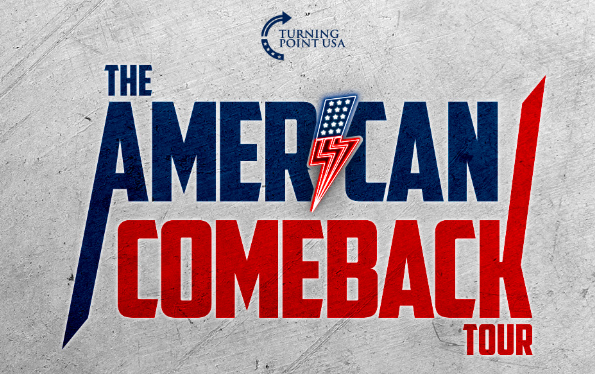
Additionally, the lightning bolt in the center of the “American Comeback Tour,” which was behind him when was shot, signals strength and what I would call, a superhero’s resolve. The nonverbal messaging is one of confidence and a willingness to engage in the battle of ideas. It stands apart from traditional party branding.
Even the personal presentation of Charlie Kirk and his wife, Erika, has an aesthetic fittingness related to particular events, always respectful of tradition and modesty. Their public presentation emphasizes a wholesome image of biblical marriage and family. For formal events, their dress communicates seriousness and professionalism. Charlie’s personal aesthetic signaled, above all, stability and normalcy in an age of moral confusion. His aesthetic perfectly embodies what his organization advocates.
When Charlie was on a university campus, he wore casual clothes, such as jeans and a graphic t-shirt. This communicated his openness to engage with youth in a civil, casual discussion on their turf. The t-shirt he wore to his last campus event was a white t-shirt with one simple word printed in black across the front: FREEDOM. His messaging was always clear, concise, and without ambiguity. There was nothing bizarre, confusing, or dehumanizing in his presentation.
Thinking about the aesthetics of Charlie Kirk and his organization reminds us that the aesthetic side of life is at the center, not the fringe of life. It is ubiquitous. Charlie Kirk set an example of memorable branding and personal appearance that enhanced his message. He represented truth well and I’m sure TPUSA will continue to do the same.
Most importantly, he demonstrated how powerful aesthetics are; the nonverbal elements are a presentation all by themselves. The aesthetics of Charlie Kirk reminds us that our calling as Christians is to be the most creative, most compelling, and most effective people in the world.
Unlike animals, God created human beings with the capacity to experience the aesthetic side of life and utilize it for His kingdom. There is much more to say and examine on this score, but I think Charlie Kirk set an incredible example of how to harness the power of aesthetics in his particular ministry.
As Christians, our primary message, the gospel of Jesus Christ, is first of all verbal, but it is also visual and stylistic. Our use of symbols, dress, and environments convey meaning beyond words. Persuasion flows through the aesthetic, just as it does through reasoned discourse.
Listen to a recent interview on the subject of art and apologetics, including a discussion on this topic.
Very well said and something of which I was aware, but hadn’t really processed.
Hi Paul,
Appreciate your kind words, thank you!
Excellent article Scarlett. Your take is, like you said, one I have not heard addressed. We’ll said.
Hi Shanna,
Thanks for taking the time to check it out! -Scarlett
Awesome work and thanks for sticking to the truth. In memory of Charlie Kirk: I met Charlie twice once in San Antonio at an event at TUSA in September, and again at an annual Freedom Rally in Phoenix in December 2024. It became a perfect realization of the impact he was making during a critical and decisive time in our nation’s history. He was humble, kind, loving, and accepting of everyone he met, exemplifying His true love and commitment to being an example of an example of Jesus Christ, and Father to his beautiful wife and children. May God continue to bless them all and Americans who loved him in the coming months and years, in honoring his life and legacy, as he would have wanted.
PS RC